Hopi Contemporary figures (not kachina) large
Gregory Lomayesva
18777
Add photos & documents
Drop photos or documents here — images of the work, record cards, receipts, certificates, exhibition papers.
JPEG, PNG, WebP, or PDF, up to 25 MB each. You confirm what each file is before it joins the record.
Details
- Age
- 1990
- Style
- hopi katsinam
- Artist
- Gregory Lomayesva
- Origin
- Hopi, AZ
- Material
- wood and paint
- Condition
- Exxcellent
- Dimensions
- 30'' H x 15'' W x 5'' D
Conflicts
No open conflicts between this record’s accounts.
Description
Imported
Greg Lomoyasva, Hopi, purchased from Canyon Road gallery circa 1990
Artist Bio
Imported
Gregory Lomayesva : From Auction Records Pair of Parrot Katsinam Art images copyright© of artist or assignee Previous Next Inspired by his father, Bill, a woodcarver and jewelry designer, and his mother, Marie Romero Cash, a carver of wooden saints, he both paints and carves figures but does not call them kachinas. He does contemporary, often sarcastic depictions of Hopi images, which have caused him conflict with his own tribe. In October, 1998, he had a special exhibit of his work at the Turquoise Tortoise Gallery in Sedona. Selected Exhibitions: 2006 "The Art of War" at Art & Industry, Santa Fe 2004 "16:9" at Peyton Wright Gallery, Santa Fe 2003 "Bent" at Peyton Wright Gallery, Santa Fe 2002 "Curves Ahead" at Peyton Wright Gallery, in Santa Fe 2001 "Common bonds" at Peyton Wright Gallery, in Santa Fe 2000 STAP project ... Displaying 750 of 1434 characters.
Conversation
No entries yet.
Research
Subject & Iconography
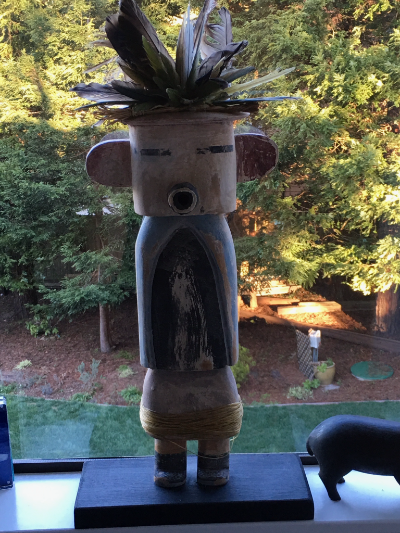
The figure presents a front-facing anthropomorphic form with a large, mask-like head bearing simple geometric facial features: small rectangular eyes rendered in blue-grey, a circular open mouth, and wide ear-like lateral projections painted in a warm rose-brown. A flat, disc-like hat or tableta sits above the head, from which a substantial fan of dark feathers radiates upward. The cylindrical body is painted in a dark graphite-black field with a lighter central panel and grey torso, creating a strong geometric contrast. The legs are short and stubby, and the midsection is bound with wrapped fiber cord. The figure stands on a rectangular black plinth. This iconographic vocabulary — the mask-face with geometric eyes and round mouth, the lateral ear tabs, the feathered headdress, and the wrapped waist — is consistent with Lomayesva's katsina-inspired aesthetic: the katsina-styled figures are representative of his Hopi roots but explicitly not representative of actual kachina figures. He has described beginning pieces with Hopi imagery and then adding his own abstract designs. The overall visual language is closer to folk-art Pop than to ceremonial tithu carving.
Historical & Cultural Context
Lomayesva began combining his woodworking skills with Hopi imagery into fusion sculptures from an early stage in his career. His deliberate refusal to call his figures 'kachinas' reflects both a personal artistic position and a response to ongoing tensions around the commercialization and appropriation of sacred Hopi imagery. His work has been described as 'contemporary, often sarcastic depictions of Hopi images, which have caused him conflict with his own tribe.' This context is important for understanding why the record's collection note ('Hopi Contemporary figures — not kachina') is not merely a taxonomic nicety but a point the artist himself insists upon. Traditional Hopi katsina figures (tithu) are carved from cottonwood root as ceremonial or educational objects; they are given to young Hopi girls and serve as teaching tools about katsina spirits. Lomayesva's figures depart from this tradition, embedding Hopi visual language within a broader Pop and contemporary folk-art practice that also references Roy Lichtenstein, Andy Warhol, and Robert Rauschenberg. A 1998 solo exhibition at Turquoise Tortoise Gallery in Sedona marks one early anchor in his exhibition record; his gallery presence expanded significantly through Peyton Wright Gallery in Santa Fe from 2001 onward. He has since become internationally recognized, with works in the Museum of New Mexico Foundation shops and a presence at Richard Levy Gallery.
Type & Form
This is a large, freestanding contemporary figurative wood sculpture in the Hopi katsina-inspired style. The record explicitly titles it a 'contemporary figure (not kachina),' a designation that faithfully reflects the artist's own practice: his sculptures draw on katsina iconography but are intentionally not representations of actual katsinam. At 30 inches tall, it falls within the upper size range for this body of work — a 1994 comparable by the same artist sold at auction measured 35.5 inches, and a 2004 work appeared at 31¾ inches. The figure stands on a flat black wood base, consistent with the mounting conventions seen across Lomayesva's three-dimensional output throughout the 1990s and early 2000s. The piece sits at an intersection between contemporary American folk art and Pop Art-inflected sculpture, a market category distinct from traditional ceremonial katsina dolls.
Materials & Construction
The record identifies the materials as wood and paint, consistent with the artist's known technique across comparable works. Auction records for Lomayesva's figurative sculptures of this period consistently describe 'carved and painted wood' with feather headdresses — one 1997 piece is catalogued as 'polychrome painted carved wood' with decorative feathers mounted on a wood base, and a 2001 mask as 'carved and painted wood with feathers.' Traditional Hopi katsina figures are carved from cottonwood root, a soft, lightweight wood that has been the standard material since at least the early 20th century; whether this figure uses cottonwood root, another wood, or a composite is not specified in the record. The feather spray crowning the headdress appears lush and dark green in the photograph; the Museum of New Mexico Foundation's notes on Lomayesva's work state that 'the feathers used are molted parrot feathers that add rich coloration to each work.' The body shows a wrapped or bundled waist treatment that may involve yarn or fiber cord, visible in the photograph, consistent with decorative binding seen on comparable pieces. Paint is applied in flat, graphic zones of grey, black, and brown-rose — a palette aligned with his early 1990s output.
Record assessment
The record is moderately well-founded. Attribution to Gregory Lomayesva is plausible and consistent with the figure's visual vocabulary, materials, and the artist's known early output — and is corroborated by the existence of an auction-listed 'Kachina, 1990' by Lomayesva, suggesting the date is not implausible even given his birth year of 1971. The Canyon Road gallery provenance is contextually credible but unverified: no receipt, gallery name, or purchase document is preserved in the record, so the provenance chain rests entirely on the owner's recollection. The condition, dimensions, and collection placement are all internally consistent. The most important gaps to address are: (1) Signature documentation — a close photograph of the back or underside of the figure, or the base, is urgently needed, since Lomayesva consistently signed and dated works on the verso or base from his earliest known pieces; the presence or absence of a signature and date is the single most significant factor for authentication and market value. (2) Gallery identification — even a partial name or address of the Canyon Road dealer would allow cross-referencing with Lomayesva's early representation history. (3) A sharper photograph of the feather headdress material, to confirm whether these are molted parrot feathers (characteristic of Lomayesva's work per multiple gallery sources) or another species, which has bearing on both attribution confidence and any regulatory considerations under the Migratory Bird Treaty Act.
From research, August 7, 2026
Owner Notes
Owner
Owner reviewed and accepted this attribution finding, as written, from a research report: The record attributes the work directly to Gregory Lomayesva (also spelled Lomoyasva in the record's title field, a minor variant). Lomayesva was born in 1971 in Santa Fe, New Mexico, which creates a noteworthy tension with the record's date of 1990: if accepted, the figure was made when the artist was approximately 18 or 19 years old. Artnet's database does list a work titled 'Kachina, 1990' by Lomayesva that sold at auction in September 2024, confirming that 1990-dated works by him exist and have reached the secondary market. The artist is the son of Maria Romero Cash, a celebrated Hispanic santera who taught him to carve, and William 'Bill' Lomayesva, a Hopi painter and jewelry designer — a heritage that directly informs this figure's form. The record gives a Canyon Road gallery, Santa Fe, as the acquisition source, which is plausible: Canyon Road has been a major hub for Native American and contemporary Southwest art for over six decades, and Lomayesva has been represented by galleries in the Santa Fe ecosystem throughout his career. No receipt or gallery name is preserved in the record, so direct provenance to a specific Canyon Road dealer cannot be confirmed.
Owner
Owner reviewed and accepted this value estimate finding, as written, from a research report: Lomayesva's three-dimensional works have a documented secondary-market record across multiple auction houses. MutualArt reports realized prices ranging from $110 to $5,000, with the auction record of $5,000 set in 2020 at Freeman's | Hindman Denver for a work titled 'We are Not Seeking.' His sculptures regularly appear at Santa Fe Art Auction, John Moran Auctioneers, Davis Brothers, and Larsen Art Auction. A 1994-dated standing kachina figure by Lomayesva, measuring 35.5 inches and described as a 'tall figure with painted wood mask and tableta with multicolored feathers,' provides the closest dimensional comparable identified; a 2004 carved and painted wood katsina with feathers (31¾ x 23½ x 8 inches) is also relevant. The present work's date of circa 1990 makes it among the earliest known works by the artist to appear in a collection context — Artnet lists a 'Kachina, 1990' that sold in September 2024 — which may carry a modest early-work premium for a collector audience, though early works by Lomayesva do not yet show a systematic market advantage over later pieces. At 30 inches, with feather headdress intact and in excellent condition as recorded, a plausible current retail/secondary market range for a large, early Lomayesva figure in this category would be approximately $800–$3,500, depending heavily on whether the piece is signed (not confirmed in the record) and on demand at the venue of sale. This estimate is hedged: no direct auction record for a 1990-dated figurative sculpture of this scale by Lomayesva was identified in the searches conducted.
Chat with this object
Ask about provenance, materials, or the artist's biography. Answers are grounded in this object's records; gaps are named, not invented.