Albert Looking Elk Taos
Albert Looking Elk Martinez
15548
Add photos & documents
Drop photos or documents here — images of the work, record cards, receipts, certificates, exhibition papers.
JPEG, PNG, WebP, or PDF, up to 25 MB each. You confirm what each file is before it joins the record.
Details
- Age
- 1935
- Style
- Western New Mexico
- Artist
- Albert Looking Elk Martinez
- Origin
- Taos New Mexico
- Material
- Oil on canvas
- Condition
- Excellent
- Dimensions
- 12'' H x 14'' W
- Estimated Value
- $2,500.00
Conflicts
No open conflicts between this record’s accounts.
Description
Imported
Oil on canvas painting of Taos Pueblo in the 1930s painted by local towels, painter of the few painters who was allowed to paint the Pueblo.
Artist Bio
No entries yet.
Conversation
No entries yet.
Research
Subject & Iconography
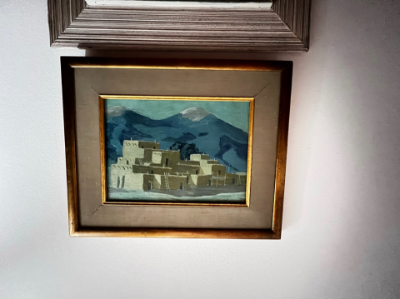
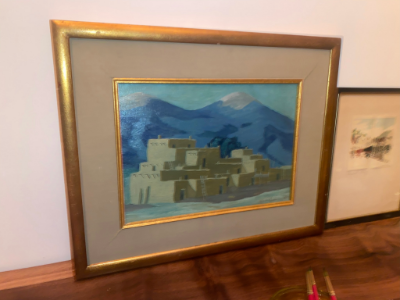
The composition is a straightforward, naturalistic view of the multi-storied adobe structures of Taos Pueblo seen from a slight distance, with small human figures visible at the base of the buildings to convey scale. Behind the pueblo rises a dramatic range of blue-toned mountains capped with snow, consistent with the Sangre de Cristo Mountains that form the backdrop of the actual site. The palette is dominated by muted earth tones — ochres, tans, and warm browns — for the adobe, with cool deep blues and whites in the mountain register. The composition is typical of Looking Elk's primary subject matter: he is documented as having painted the Pueblo itself repeatedly, preferring "prosaic, non-romanticized scenes" rendered in a naturalistic European oil-painting idiom. The atmospheric use of light and color in the mountain zone is consistent with contemporary descriptions of the artist's work, which note that he "painted with more atmospheric light and color than Lujan, giving his work much appeal to tourists."
Materials & Technique
The record identifies the medium as oil on canvas. This is consistent with the artist's known practice: Berninghaus set Looking Elk up with oil paints, easel, brushes, and canvas, and oils on canvas or board are the media in which the artist is primarily documented. Many of his works are on canvas board or panel rather than stretched canvas, and auction records list both formats; the record here states canvas specifically. The handling visible in the photographs — broad, confident strokes in the mountains and simplified but solid modelling of the adobe volumes — is consistent with the informal, self-taught European realist approach described by gallery and scholarly sources.
Historical Context
Looking Elk, Albert Lujan, and Juan Mirabal emerged as painters in the first decades of the twentieth century within the milieu of the Anglo Taos Art Colony. Beginning in the 1890s, painters such as Joseph Sharp, Ernest Blumenschein, and Bert Phillips arrived in Taos and painted the Pueblo and its residents; Taos Pueblo inhabitants, including Looking Elk, served as paid models for these artists, particularly for Taos Society of Artists founders such as Couse and Berninghaus. A handful of Taos Pueblo residents subsequently adopted the European easel-painting tradition, using newly learned oil-painting techniques to depict their own community from their own perspective. Their work was, however, initially dismissed or shunned by mainstream collectors and institutions, including the Museum of New Mexico Fine Art Gallery, because it was considered too close in style to the work of the Anglo Taos painters. The 1930s, the decade from which this work dates, represent the mature phase of Looking Elk's career. He was elected Governor of Taos Pueblo in 1938, two years before his death. The three artists are today recognized in museum collections, most notably in a major gift of 42 paintings to the Millicent Rogers Museum in Taos that constitutes the largest public collection of works by these Pueblo painters. Note: the record entry reads "1935 BC" for the age field, which is clearly a data-entry error — the painting dates to approximately 1935 CE.
Type & Category
This is a small easel painting — oil on canvas — depicting Taos Pueblo, New Mexico, and is attributed to Albert Looking Elk Martinez (c. 1888–1940), one of the recognized "Three Taos Pueblo Painters." The record describes it as a Western New Mexico–style work dating to approximately 1935, measuring 12 inches high by 14 inches wide. At that scale it is somewhat larger than the postcard-sized works most commonly associated with the artist, who frequently produced small tourist-oriented panels, though larger canvases are documented in the market record. The painting is housed in a period gilt wood frame with a grey/taupe fabric mat, visible in both catalogue photographs.
Record assessment
The record is well-grounded in its biographical claims about Albert Looking Elk Martinez — the artist is documented in multiple scholarly and gallery sources, and the subject matter, medium, scale, and approximate date are all consistent with what is known about his output. The condition note (excellent), dimensions, and medium (oil on canvas) are recorded. That said, the record rests almost entirely on tradition rather than documentation: there is no purchase receipt, no gallery or seller name, no provenance chain, and no prior appraisal or exhibition history. The "1935 BC" entry in the age field is a data-entry error that should be corrected to circa 1935 CE. Most critically, neither photograph clearly shows the lower-right corner of the canvas at close enough resolution to confirm the signature, which is the single most important authenticating detail for this artist. To materially strengthen this record, the most urgent steps are: (1) a dedicated close-up photograph of the lower-right corner of the painted surface to document or rule out the "Albert Looking Elk" or "Looking Elk" signature that auction records consistently describe; (2) a photograph of the entire verso of the canvas, including any inscriptions, labels, stamps, or stretcher markings, which on at least one documented comparable carried a signed letter from the artist; (3) any purchase receipt, bill of sale, or correspondence naming the seller or gallery; and (4) a formal appraisal by a specialist in Southwest Native American art, particularly given that the $2,500 owner estimate exceeds the documented public auction ceiling for this artist and would benefit from specialist support if the work is to be insured or sold at that figure.
From research, July 30, 2026
Owner Notes
Owner
Owner reviewed and accepted this attribution finding, as written, from a research report: The record attributes this painting to Albert Martinez, whose Tiwa name T'o'nu translates as "Looking Elk," born around 1888 at Taos Pueblo, New Mexico, and died there on November 30, 1940 (some sources list 1941). He is one of the three individuals identified by scholars as the "Three Taos Pueblo Painters," the others being Albert Lujan and Juan Mirabal. He entered the art world as a model for Eanger Irving Couse, a founding member of the Taos Society of Artists (TSA), and later modeled for Oscar E. Berninghaus, another TSA founder. By around 1915, Berninghaus gifted him oils, brushes, an easel, and canvas, and gave him his only formal art lessons, launching his painting career. By 1917 at the latest, he was producing oils; a 1918 notice in the Taos Valley News is the earliest known press attention to his work. He was elected Governor of Taos Pueblo in 1938, and won first place at the Southwest Association for Indian Arts (SWAIA) in 1923. The record's date of "1935" is plausible: it falls squarely within his mature, active period. The record's note that he "was allowed to paint the Pueblo" reflects a real and documented access privilege — as a resident Native, he could paint the Pueblo at any hour, an access no outsider painter possessed. No signature is described in the object record, and neither catalogue photograph shows a lower-right corner at sufficient resolution to confirm a signature. Auction records confirm the artist typically signed works "Albert Looking Elk" or "Looking Elk" in the lower right.
Owner
Owner reviewed and accepted this value estimate finding, as written, from a research report: The record carries an owner estimate of $2,500. Public auction data for Looking Elk is limited — askART lists only 17 auction lots, of which 16 sold. MutualArt records realized prices in a range of $1,400–$1,968 USD since 2012, with the auction record at $1,968 for "Mounted Figures" sold at Cowan's in 2013. These comparables are almost entirely small works (postcard to 8×10-inch scale) on board or canvas board. The present work is on canvas and, at 12×14 inches, is meaningfully larger than most documented auction comparables, which typically command less. Gallery offerings for similar-scale Looking Elk oil-on-canvas works have appeared at Adobe Gallery, Santa Fe, though realized prices there are not publicly disclosed. The owner's $2,500 estimate is plausible for a larger-than-average, intact, well-conditioned canvas by this artist, particularly given growing institutional and collector recognition of the Three Taos Pueblo Painters group; however, it is above the documented public auction ceiling and should be treated as a private-sale or gallery estimate rather than a confirmed auction value. A signed work in this format with documented provenance could support or exceed that figure in a specialist Southwest art venue; an unsigned or unverified work would likely sell at the lower end of, or below, the documented auction range.
Owner
Albert Looking Elk Martinez (Albert Martinez, a.k.a. Looking Elk), 1888–1940. With Albert LuHan and one Mirabelle, among the Taos painters. Model for the Taos Society of Artists. Began to paint after 1915, when he was probably 25 or 30 years old.
Chat with this object
Ask about provenance, materials, or the artist's biography. Answers are grounded in this object's records; gaps are named, not invented.