Nwc Rudolph, James medium totem pole
James Rudolph
18824
Documents
Record card · transcribed · confidence 0.97
Add photos & documents
Drop photos or documents here — images of the work, record cards, receipts, certificates, exhibition papers.
JPEG, PNG, WebP, or PDF, up to 25 MB each. You confirm what each file is before it joins the record.
Details
- Age
- 1920
- Style
- Nwc
- Artist
- James Rudolph
- Origin
- Tlingit
- Material
- Cedar
- Condition
- Excellent
- Dimensions
- 11'' H x 2'' W x 2.5'' D
- Estimated Value
- $3,000.00
Conflicts
No open conflicts between this record’s accounts.
Description
Imported
Medium yellow cedar nwc totem james rudolph
Artist Bio
No entries yet.
Conversation
No entries yet.
Research
Type & Form
This object is a Northwest Coast Tlingit model totem pole — a miniature carved pole produced for sale and trade rather than as a monumental clan marker. Model totem poles of this kind were first created by Northwest Coast Native carvers supplying curios for the Pacific Northwest souvenir trade in the late nineteenth century, and by the early twentieth century the form had become a recognised art object in its own right. The record catalogs it under 'North West Coast Totem Poles' and 'Sculpture,' which accurately reflects its dual status as both ethnographic artifact and fine art. The pole is described in the appraisal document as dating to circa 1915–1920, placing it firmly within what scholars of the form identify as an early, high-quality phase of model pole production.
Materials & Construction
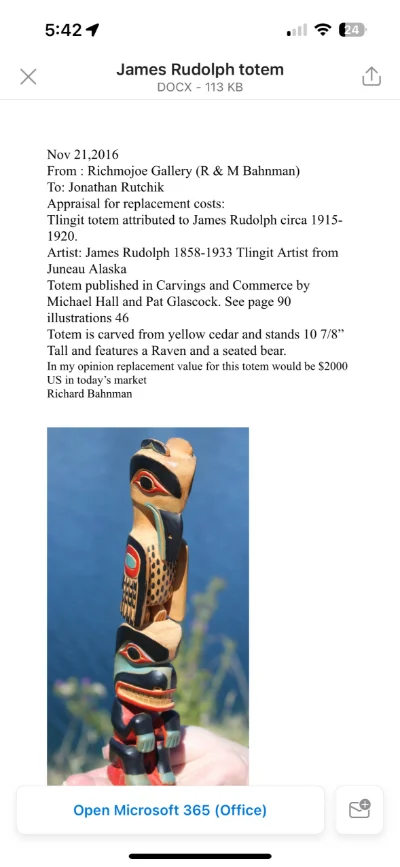
The pole is carved from yellow cedar (Callitropsis nootkatensis), a wood prized by Northwest Coast carvers for its fine grain, workability, and durability. Yellow cedar was a traditional carving material widely used by Tlingit artists, and its use here is consistent with Rudolph's documented practice: a near-identical model pole at auction was described as 'carved and painted cedar.' The record gives dimensions of 11 inches tall by 2 inches wide by 2.5 inches deep; the appraisal document records the height slightly differently at 10 7/8 inches, a difference of an eighth of an inch that likely reflects rounding or measurement method. The surface is polychrome-painted, with the photograph showing the characteristic Tlingit palette of red, black, teal-green, and natural cedar tones. Condition is recorded as excellent.
Subject & Iconography
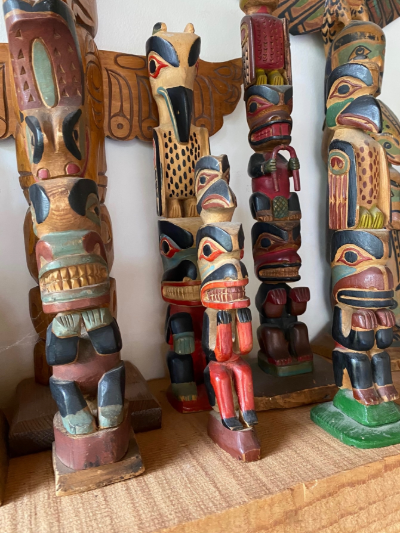
The appraisal document states that the pole features a Raven and a seated bear — two of the most important crest figures in Tlingit oral tradition. Raven is the central figure in Tlingit cosmology, credited with shaping the world and bringing light. Bear is a powerful clan crest. The catalogue photograph shows bold, formline-derived painted decoration in the classic Northwest Coast palette of red, black, and teal, with prominent oval eyes, defined brow forms, and stacked figures typical of Tlingit model poles. A separate Richmojoe Gallery listing for another Rudolph pole from circa 1910 describes similar iconography — 'a seated bear on top, raven and seated human at the bottom' — suggesting Rudolph regularly combined these crest figures in his model poles. The pole stands just under 11 inches tall, a scale typical of Juneau-area tourist-trade model poles of the period.
Historical & Cultural Context
James Rudolph worked at the intersection of traditional Tlingit artistic practice and the early twentieth-century Northwest Coast tourist economy. Model totem poles were first created by Northwest Coast Native carvers in the late nineteenth century for sale to non-Native visitors; by Rudolph's most active years (roughly 1900–1930), Juneau had become a major port of call for Alaska-bound tourists, and the local curio trade was substantial. The Nugget Shop in Juneau was one of the principal retail outlets for such work, and at least one other Rudolph pole bears an old Nugget Shop stamp on the back. Rudolph simultaneously maintained his cultural standing within the Tlingit community, receiving the major commission for the Thunderbird House screen for the Áakʼw Ḵwáan Wooshkeetaan (Eagle/Shark clan). His work was exhibited in Paris in 1931, indicating recognition well beyond the local souvenir market. 'Carvings and Commerce,' the 2011 University of Washington Press catalogue edited by Michael D. Hall and Pat Glascock, positions Rudolph among the significant early-phase model pole carvers and reproduces this specific type of pole as a primary example.
Record card — OCR'd from image-001.png · August 20, 2026 · confidence 0.97
James Rudolph (1858–1933) was a Tlingit artist from Juneau, Alaska.
The totem is a Tlingit totem pole.
The totem is carved from yellow cedar.
The totem stands 10 7/8 inches tall.
The totem features a Raven and a seated bear.
The totem is published in 'Carvings and Commerce' by Michael Hall and Pat Glascock, page 90, illustration 46.
The totem is a Tlingit totem pole.
The totem is carved from yellow cedar.
The totem stands 10 7/8 inches tall.
The totem features a Raven and a seated bear.
The totem was published in 'Carvings and Commerce' by Michael Hall and Pat Glascock, page 90, illustration 46.
Record assessment
This is a well-documented record for a category where documentation is often scarce. The attribution to James Rudolph rests on a contemporaneous written appraisal from a specialist dealer (Richmojoe Gallery / Richard Bahnman, 2016), corroborated by the pole's appearance in 'Carvings and Commerce' (Hall & Glascock, 2011, p. 90, ill. 46) — a peer-reviewed scholarly catalogue that serves as the field's primary reference. The artist's biography, cultural identity, and working period are all independently confirmed by multiple gallery and archival sources. Condition (excellent) and material (yellow cedar) are also consistent with the record. The photographs are adequate but show the pole at an angle and in a group context; they do not provide a clear view of the reverse or base. Three specific gaps would meaningfully strengthen the record. First, the revision from the 2016 appraisal figure of $2,000 to the current ledger value of $3,000 has no supporting document — a note of source or a fresh appraisal should be added. Second, the record does not state whether the pole bears a dealer stamp (such as the Nugget Shop Juneau stamp documented on comparable Rudolph poles), a price inscription, or a paper label on the reverse; a dedicated photograph of the base and verso would clarify this and potentially add provenance depth. Third, acquisition provenance — the gallery or seller from whom the owner purchased this pole — is absent entirely; even a receipt or purchase note would anchor the chain of custody before the 2016 appraisal.
From research, August 20, 2026
Owner Notes
Owner
Owner reviewed and accepted this attribution finding, as written, from a research report: The totem is attributed to Tlingit artist James Rudolph, circa 1915–1920.
Owner
Owner reviewed and accepted this value estimate finding, as written, from a research report: The replacement value of the totem is estimated at $2,000 USD as of November 2016.
Owner
Owner reviewed and accepted, as written, the following reading from a Record card (image-001.png): Artist: "James Rudolph".
Owner
Owner reviewed and accepted this attribution finding, as written, from a research report: The totem is attributed to James Rudolph, circa 1915–1920.
Owner
Owner reviewed and accepted this attribution finding, as written, from a research report: James Rudolph (1858–1933) was a Tlingit artist from Juneau, Alaska.
Owner
Owner reviewed and accepted this value estimate finding, as written, from a research report: The replacement value of the totem is estimated at $2,000 USD as of November 2016.
Owner
Owner reviewed and accepted this attribution finding, as written, from a research report: The totem is attributed to James Rudolph (1858–1933), a Tlingit artist based in Juneau, Alaska. This attribution is supported by a formal written appraisal dated November 21, 2016, issued by Richmojoe Gallery (R & M Bahnman) and signed by Richard Bahnman. The appraisal document describes Rudolph as a 'Tlingit Artist from Juneau Alaska.' Photographic evidence from the Alaska State Library confirms Rudolph's identity as a Juneau Tlingit carver, with his Tlingit name recorded as Koosh-Kheet, meaning 'the master painter or artist.' He was of the Raven moiety. Beyond making model poles for the tourist and curio trade, Rudolph was commissioned to create the Thunderbird House screen for the Wooshkeetaan clan, now in the collection of the Los Angeles County Museum of Art (LACMA). He was known for creating intricate model poles with characteristic large eyebrows, bold black lines delineating bird wings on three sides, and thin hand-carved bases. His work was featured at an exhibition in Paris in 1931. The specific pole in this record is attributed 'circa 1915–1920,' consistent with Rudolph's active working period. The appraisal also notes that the pole is published in 'Carvings and Commerce' by Michael Hall and Pat Glascock (University of Washington Press, 2011), page 90, illustration 46 — a scholarly catalogue raisonné of model totem poles from 1880 to 2010, regarded as a standard reference for collectors and museum curators. A First Arts auction listing independently noted that a comparable Rudolph pole 'is nearly identical to one featured on page 90 in Carvings and Commerce.' The record does not note a maker's signature or stamp on this pole; a comparable Rudolph pole sold at auction was likewise described as unsigned.
Owner
Owner reviewed and accepted this value estimate finding, as written, from a research report: The 2016 appraisal by Richard Bahnman of Richmojoe Gallery places replacement value at $2,000 USD. The record's own estimated value is set higher at $3,000, which the owner appears to have accepted as the current ledger figure. These two figures are not reconciled in the record, and the source of the upward revision from $2,000 to $3,000 is not documented. The appraisal is now approximately a decade old; values for attributed, published early-twentieth-century Tlingit model poles have shifted since 2016. Auction data for directly comparable Rudolph model poles provides the most reliable market signal available. Two Rudolph model poles, both approximately 10–10.5 inches and dated to the 1920s, were offered at First Arts with pre-sale estimates of $800–$1,200 each; one realized $780 and another $976. A separate Waddingtons auction featuring Rudolph among a group of historic model pole makers listed comparable Dynamic Phase poles with estimates of $4,000–$5,000. These results suggest that auction hammer prices for Rudolph poles in the recent market have generally fallen in a range of roughly $800–$1,200 at the lower end, with specialist-curated offerings potentially reaching higher levels depending on provenance and condition. The published appearance in 'Carvings and Commerce' (page 90, illustration 46) is a meaningful provenance asset that can support pricing above generic comparable sales. The $2,000–$3,000 replacement (insurance) value in the record is plausible as a retail replacement figure for a published, attributed, excellent-condition example, though it sits above recent auction hammer results for the artist. The gap between retail replacement value and likely auction realisation is normal for this category.
Chat with this object
Ask about provenance, materials, or the artist's biography. Answers are grounded in this object's records; gaps are named, not invented.