Hopi Katsinam folk art Duane OHagan Taos, NM
Duane O’Hagan
19116
Add photos & documents
Drop photos or documents here — images of the work, record cards, receipts, certificates, exhibition papers.
JPEG, PNG, WebP, or PDF, up to 25 MB each. You confirm what each file is before it joins the record.
Details
- Style
- folk art
- Artist
- Duane O’Hagan
- Origin
- Tres Piedras NM
- Material
- cootonwood
- Condition
- excellent
- Dimensions
- 7'' H x 2'' W
- Estimated Value
- $500.00
Conflicts
No open conflicts between this record’s accounts.
Description
Imported
Purchased from Robert Two grace Taos, non native folk art with moveable arms circa 1975
Artist Bio
Imported
Duane O’Hagan (1938 - 2015) “Cheyenne Doll in an Orange Dress”, whimsical figure of a dancing girl in Powwow regalia, carved from a pine two-by-four, painted in richly pigmented hues and decorated with beads, pony hair, and paint. 4 inches wide at base, 10 inches tall and 2 ½ inches deep. O’Hagan’s carved and painted wooden kachinas, birds, trees, and other mythical and mystical figures are widely collected and highly regarded not only In Taos, but all around the world.
Conversation
No entries yet.
Research
Type & Form
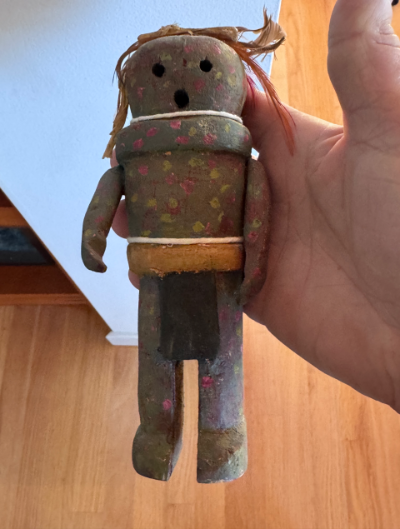
This is a small, freestanding, carved and painted wooden figure in the idiom of a Hopi-style katsinam (kachina doll). The record titles it 'Hopi Katsinam folk art' and explicitly categorizes it as 'folk art' and 'non-native.' It is not a ceremonially produced Hopi tihu but rather a non-native artist's interpretation of the kachina figure tradition — a distinct category that emerged alongside tourist and collector markets in the twentieth century. The figure stands approximately 7 inches tall by 2 inches wide, a compact scale consistent with commercially produced or studio folk-art carvings of the period.
Materials & Construction
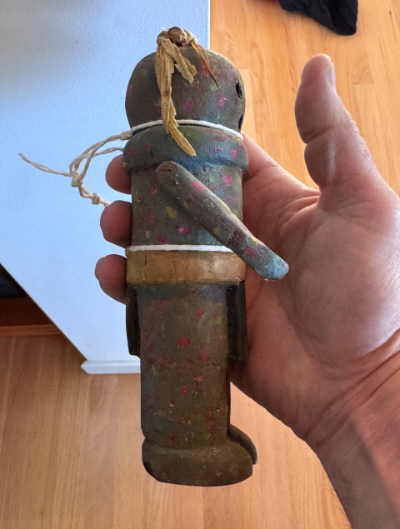
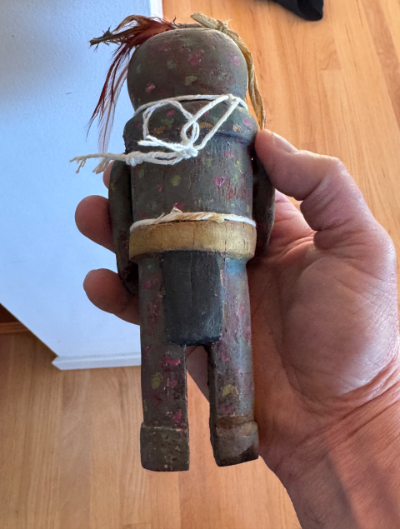
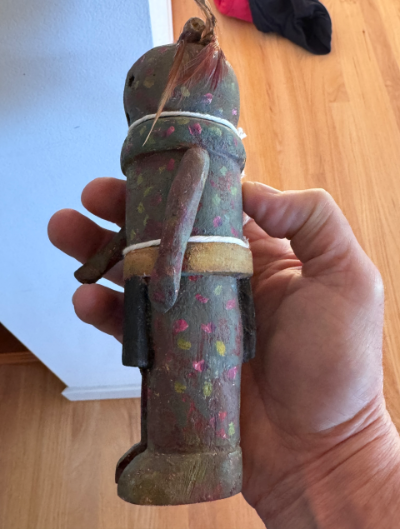
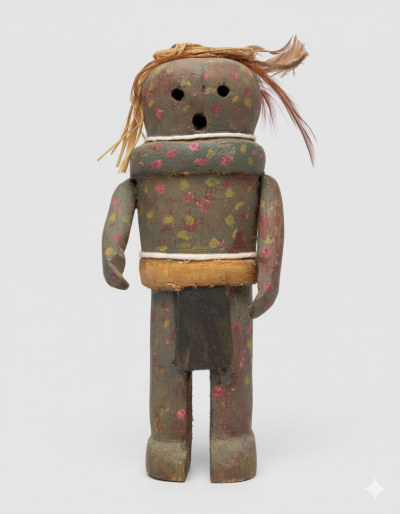
The record lists the material as 'cootonwood' (cottonwood), consistent with the traditional material for kachina-style carving in the Southwest. Cottonwood root has been the canonical medium for Hopi tihu for generations and its use by non-native folk artists in the same tradition is well documented. The photographs show the body is a single turned or hand-carved cylindrical form with a separately articulated cylindrical head; the arms are separately carved and affixed — one arm is visible in profile in multiple photographs. The surface is painted in a dark olive-grey ground with scattered spots of red, pink, and yellow-green pigment, suggesting a multicolor dot or floral motif applied over the base coat. A light-colored horizontal band (possibly a natural wood belt or strip) divides the torso. Natural fiber cordage is wrapped around the torso in a loose geometric pattern, and a tuft of what appears to be animal hair (possibly horse or buffalo) extends from the top of the head and is bound with raffia or plant fiber. The piece shows wear appropriate to approximately fifty years of age: the paint surface is abraded in places, and the cordage and hair attachments are dry but intact. Condition is described in the record as excellent.
Physical Description & Iconography
The figure is strongly columnar: a large cylindrical torso sits atop a slightly narrower lower body with minimal leg definition, typical of the 'flat' or early-action folk-art kachina style rather than the elaborate action poses of contemporary Hopi tihu. The round head has three punched holes suggesting eyes and a mouth, a device common in simplified kachina interpretations. The overall coloration — muted grey-green with polychrome dots — evokes the painted decoration of traditional katsinam without replicating any specific identified spirit. The animal-hair topknot and fiber cordage wrapping across the torso and chest echo elements seen on multiple kachina types. The moveable arms noted in the record (purchased description: 'with moveable arms') are consistent with what is visible in the side photographs, where one arm hangs freely at an angle. The record notes the figure was categorized by the seller as representing 'Hopi Katsinam' in a folk-art mode, circa 1975. No specific kachina spirit identity (e.g., Hemis, Shalako, Crow Mother) is identified in the record, and the simplified rendering does not allow a confident iconographic assignment.
Historical & Cultural Context
Tres Piedras is an unincorporated community in Taos County, northern New Mexico, located approximately 30 miles northwest of Taos at roughly 8,000 feet elevation, adjacent to the Carson National Forest. The broader Taos region has attracted artists since the late nineteenth century, and its gallery ecosystem has long included folk art, Southwest Native-inspired carving, and vernacular sculpture. Non-native artists producing kachina-inspired figures occupy a specific and legally sensitive position in the American art market. The Indian Arts and Crafts Act of 1990 (IACA) is a federal truth-in-advertising law that prohibits misrepresenting any art or craft product as Indian-produced when it is not. Kachina figures are among the items most frequently copied by non-Indians. However, the IACA and the Department of the Interior explicitly permit non-native-made items to be offered and sold if they are clearly qualified — for example, as 'Native American style' or 'folk art' — in a manner that avoids consumer confusion. The record and the physical inscription both identify O'Hagan by name and origin; the record explicitly labels the piece 'non-native folk art,' which is consistent with compliant marketing under the IACA. The circa-1975 date predates the 1990 IACA; nevertheless, the explicit non-native attribution protects the piece's marketability under current law.
Record assessment
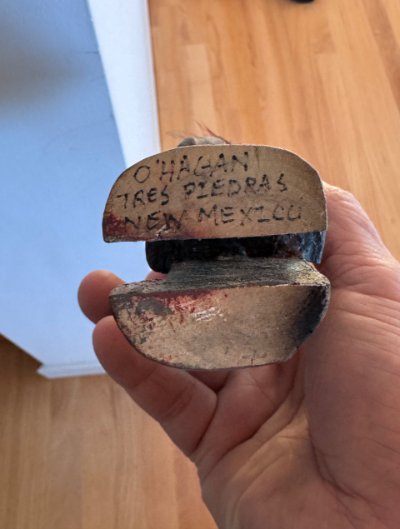
The record is moderately well-evidenced. The single strongest element is the incised maker's inscription on the base — 'O'HAGAN / TRES PIEDRAS / NEW MEXICO' — which matches all available biographical data for Duane Robert O'Hagan (1938–2015) and provides unambiguous attribution without relying solely on a paper trail. The non-native folk-art categorization and the circa-1975 date are supported by the stated provenance (purchased from Robert Two Graces, Taos) and are internally consistent, but neither a receipt nor a dated purchase document appears in the record. The $500 owner estimate is plausible but rests on no formal appraisal. The gaps most worth closing are: (1) a sharper photograph of the base inscription in flat, even light — the current hand-held shot is legible but angled; (2) a macro shot of the arm joint to document the moveable-arm feature explicitly; (3) any receipt, gallery tag, or correspondence from Two Graces Taos that would anchor the purchase date, since that directly supports both provenance and the circa-1975 dating; and (4) a formal appraisal from a Southwest folk-art specialist, as no O'Hagan hammer prices are currently accessible in public auction databases and the posthumous market for his work remains poorly documented.
From research, August 7, 2026
Owner Notes
Owner
Owner reviewed and accepted this attribution finding, as written, from a research report: The base of the figure is incised in block letters: 'O'HAGAN / TRES PIEDRAS / NEW MEXICO,' directly identifying the maker. This matches the record's attribution to Duane O'Hagan. Biographical information gathered in research confirms Duane Robert O'Hagan was born November 11, 1938, in Harlowton, Montana, and passed away January 3, 2015, at age 76, having lived in Tres Piedras, New Mexico. He was a graduate of the Ontario College of Art, whose early career as a landscape painter earned him membership in the Ontario Society of Watercolor and the Bermuda Society of Painters. Over time his practice shifted decisively toward carved and painted wooden figures. His passion, and the work for which he is most remembered, was his wooden and painted kachinas, masks, birds, and spirit figures. O'Hagan described his work as sometimes being about American mythology, Mother Earth and Father Sky, and finding the sacred in unlikely places. His creative spirit carried him across different cultural traditions, producing collections of Northwest Coast, African, and American folk-art inspired carvings. His artwork was carried by Taos Blue gallery on Bent Street, Taos, and a Norwegian secondary-market listing confirms that O'Hagan kachina masks were known internationally. The imported record further notes that his carved and painted kachinas, birds, trees, and other figures are widely collected and highly regarded not only in Taos but around the world. The record states the piece was purchased from 'Robert Two Graces Taos,' a reference to Two Graces, a Taos gallery noted for its stock of vintage Hopi kachina dolls, carved santos, and regional folk art, consistent with the provenance supplied.
Owner
Owner reviewed and accepted this value estimate finding, as written, from a research report: No auction hammer prices specific to Duane O'Hagan carved kachina figures were retrievable in the searches conducted; one LiveAuctioneers listing for 'Duane O'Hagan (20th C.) 3 Kachina Masks' was found but the realized price was not accessible. A Norwegian secondary-market listing for an O'Hagan kachina mask referenced comparable prices in the range of 3,000–6,000 Norwegian krone (approximately USD $270–$540 at current rates), though cross-currency comparisons are rough guides only. For the broader folk-art and non-native kachina market, comparables on the primary and secondary market suggest small carved figures in good condition sell in the range of approximately $300–$1,200, with better-known named makers commanding the upper end or above. The record's owner estimate of $500 sits at the lower-middle of that range and appears reasonable for a small (7-inch) non-native folk-art figure by an identifiably signed artist of regional reputation. If O'Hagan's market strengthens posthumously — he died in 2015 and his work is described as internationally collected — the estimate could be conservative. No formal appraisal is documented in the record.
Owner
Hopi Katsinam folk art piece is associated with Duane O'Hagan of Taos, NM.
Chat with this object
Ask about provenance, materials, or the artist's biography. Answers are grounded in this object's records; gaps are named, not invented.