Hopi Katsinam Chaveyo Ogre
Unknown
19173
Add photos & documents
Drop photos or documents here — images of the work, record cards, receipts, certificates, exhibition papers.
JPEG, PNG, WebP, or PDF, up to 25 MB each. You confirm what each file is before it joins the record.
Details
- Age
- 1940
- Style
- hopi
- Artist
- Unknown
- Origin
- hopi
- Material
- Cottonseed
- Condition
- Excellent with feathers removed
- Dimensions
- 5'' H
- Estimated Value
- $650.00 - $1,500.00
Conflicts
No open conflicts between this record’s accounts.
Description
Imported
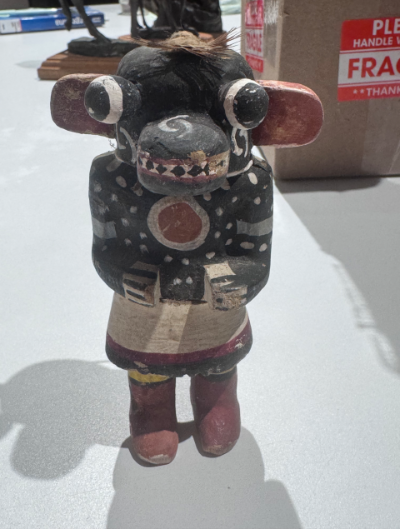
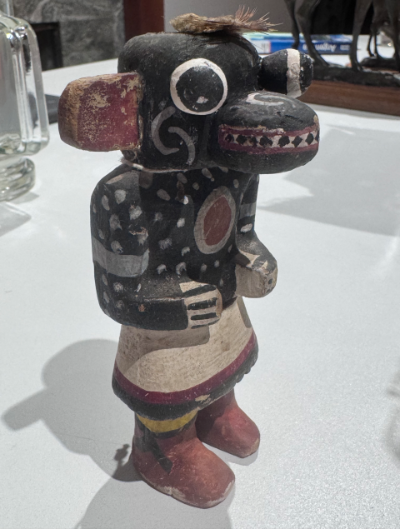
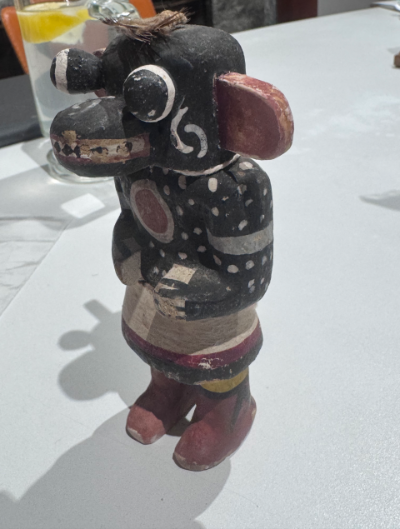
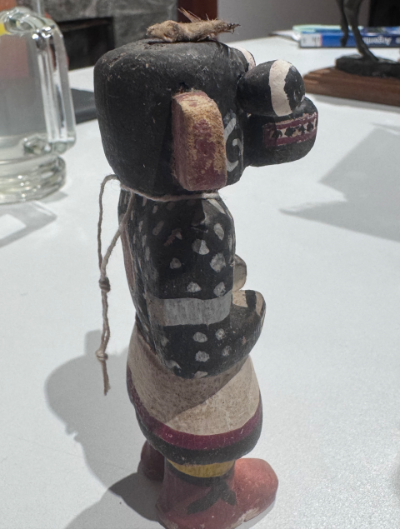
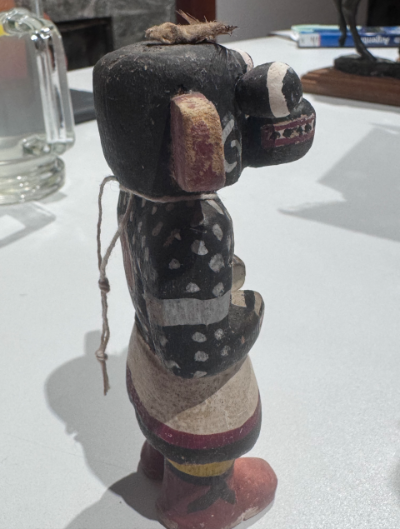
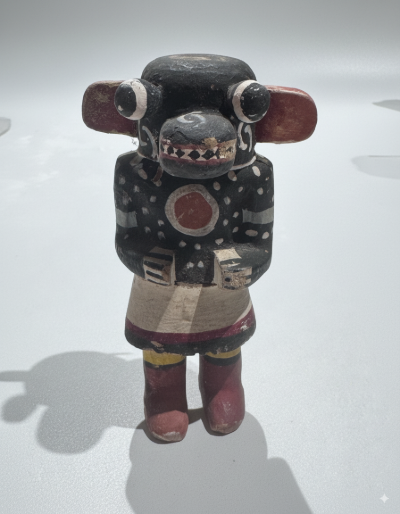
Black headed with red ears, broad checkered black white and red mouth and spots on the chest with a large red spot with white skirt and yellow stripes on the legs. Purchased from Robert Cafazzo at Two Grace Taos. He reports likely 1940. 5”.
Artist Bio
No entries yet.
Conversation
No entries yet.
Research
Type & Ceremonial Role
This object is a tihu (kachina doll) — a carved figure representing a Hopi spirit being (katsina). Specifically, it depicts Chaveyo, the Giant Ogre katsina, one of the most fearsome figures in the Hopi pantheon. Chaveyo belongs to the broader group of Ogre Katsinam, characterized by bulging eyes, a protruding snout, and a fierce demeanor. His role in ceremony is disciplinary: he appears during the spring katsina season — especially at Powamuya (Bean Dance) and Palölökongti (Water Serpent Dance) — to confront Hopi community members who have failed to meet their social or communal obligations, and to frighten children into proper behavior. Chaveyo is also regarded as the patriarch of the Nataskas, a family of dread ogres, and his spouse is Hahai-i-Wuhti. He is considered one of the most cosmopolitan katsinam, represented across nearly every pueblo, though for the Hopi his spiritual home is in the San Francisco Mountains of Arizona.
Physical Description & Iconography
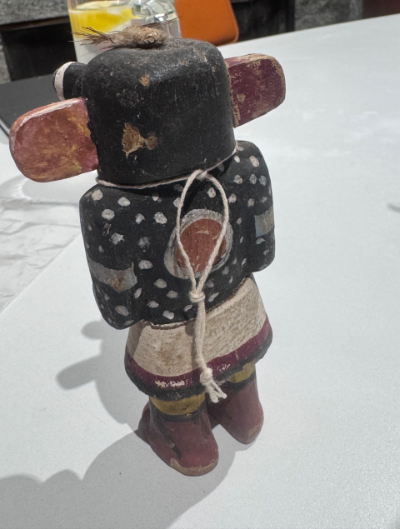
The doll stands 5 inches tall and presents the classic Chaveyo silhouette: a broad, squared-off black head with large protruding red ears, prominent goggle-style eyes with white swirl markings on the cheeks, and a wide checkered mouth in black, white, and red suggesting bared teeth. The torso is painted black and covered with white polka-dot spots; a large circular red spot with a white center adorns the chest — consistent with the record's description and clearly visible in all five photographs. Arms are tucked close to the body in the blocky, low-relief style typical of mid-20th-century Hopi carving. The garment area shows a natural-toned (unpainted) white kilt, with a narrow red horizontal band at the hem and yellow stripes on the lower legs. The feet and lower legs are painted red-pink, representing moccasins. The back view (photographs 4–5) reveals a cord or string loop tied at the upper back, a feature seen on some traditional hanging or display pieces. A small tuft of what appears to be natural fiber or feather stub remains at the crown of the head; the record notes the feathers have been removed, leaving only the attachment point. The record describes condition as 'excellent with feathers removed,' and the photographs are consistent with that assessment — paint is largely intact with expected surface wear appropriate to an approximately 80-year-old piece.
Materials & Construction
The record lists the material as 'Cottonseed,' which is almost certainly a data-entry error or transcription variant for cottonwood root — the universal and culturally mandated carving medium for authentic Hopi kachina dolls. All authoritative sources confirm that genuine Hopi tihu are carved from the root of the cottonwood tree (Populus fremontii), known to the Hopi as Paako ('water wood'), selected for its spiritual association with water and its light, easily worked grain. Dolls made from other materials are generally considered later tourist-trade production or non-Hopi manufacture. The photographs show a compact, single-block carving consistent with cottonwood root construction: the head, torso, and legs appear to be carved from one piece, with the ears and possibly the snout added as separate elements — a construction method well documented in 1940s Hopi work. Pigment application appears to be paint over a white gesso or kaolin slip ground, as was common in the mid-20th century. The fiber tuft at the crown is the remnant of what was likely a bundle of feathers secured by cord, a technique noted as characteristic of early and mid-century Hopi carving practice.
Historical & Stylistic Context
The circa-1940 date assigned by the seller is plausible and consistent with the doll's physical characteristics. Hopi carvers working in the mid-20th century produced figures with short legs, a long torso, arms carved close to the body, and a proportionally larger head — exactly what is visible here. By the 1940s, figures had begun to depict greater detail and motion than earlier blocky forms, but carvers had not yet adopted the highly articulated, action-posed style of the post-1970 era. Individual carvers did not routinely sign their work until the 1960s, which aligns with the absence of any signature on this piece. The fabric clothing tradition — where the kilt zone is left in natural unpainted wood tone to suggest a textile kilt — was also common in pre-1970s Hopi work. The use of a string loop at the back, visible in photographs 4 and 5, reflects a display or gifting convention of the period. It is believed Chaveyo was originally from the Northern New Mexico Pueblos but has been a Hopi katsina for as long as can be remembered, and slight variations in his dress and attributes have evolved across the three Hopi mesas.
Provenance & Source
The record states the piece was purchased from Robert Cafazzo at Two Graces, Taos, New Mexico. Two Graces is a well-documented Taos gallery and curio shop operated for more than twenty years by Robert Cafazzo and Holly Sievers, with an established specialty in vintage pre-1960s Hopi kachina dolls among its inventory of rare books, Southwest antiques, and Native American objects. The gallery's own listings confirm it carries vintage pre-1960s Hopi kachina dolls and that Cafazzo actively acquires and sells them. The gallery also offers a kachina doll repair service. Cafazzo reportedly attributed the doll to circa 1940, which is a dealer's working estimate rather than a documented date, but it is consistent with the object's physical style. No purchase receipt, prior collection history, or earlier provenance is noted in the record.
Record assessment
This record is moderately well-evidenced for a secondary-market vintage kachina purchase. The Chaveyo identification is solid: the photographs confirm every canonical diagnostic — black head, large red ears, goggle eyes with white swirl markings, spotted torso, broad checkered mouth, and natural-toned kilt — and the identification is consistent with established museum and gallery literature. The circa-1940 date and the stylistic fit (compact blocky form, large head, arms close to body, no signature) are mutually reinforcing, though the date ultimately rests on the seller's verbal report rather than documentary evidence such as a dated receipt, prior collection label, or scientific analysis. The provenance chain begins and ends with the purchase from Two Graces, a reputable and documented Taos dealer with a demonstrated specialty in pre-1960s Hopi kachina dolls — a meaningful positive signal, but not a substitute for earlier chain-of-custody documentation. The material field reads 'Cottonseed,' which is almost certainly a transcription error for cottonwood root and should be corrected in the record. Three items would most improve this file: (1) a dated purchase receipt from Two Graces confirming acquisition price and any representations Cafazzo made about age or origin — this is the single most important missing document; (2) a close-up photograph of the feather attachment point at the crown and the string loop at the back, both period-diagnostic features not captured in adequate detail by the current images; and (3) a formal written specialist appraisal to replace the owner-entered value estimate before any insurance or sale reliance.
From research, August 9, 2026
Owner Notes
Owner
Owner reviewed and accepted this attribution finding, as written, from a research report: The carver is unknown; no signature is present and none is indicated in the record. This is consistent with the pre-1960s period: individual Hopi carvers did not routinely sign their work until after that decade. No stylistic or clan attribution has been attempted in the record or by the seller. The doll cannot presently be linked to a named carver on the basis of available evidence. Attribution to a specific Hopi mesa or village is not possible from photographs alone, though the style is consistent with broadly documented mid-century Hopi work rather than Zuni (Zuni dolls of the period tend to be taller, thinner, and more angular, while Hopi dolls are stockier — as this example is).
Owner
Owner reviewed and accepted this value estimate finding, as written, from a research report: The record's estimated value of $650–$1,500 is within a defensible range for an unsigned, circa-1940 Hopi Chaveyo doll in excellent condition, though the 5-inch size is on the smaller end of the market and will exert downward pressure relative to larger comparable pieces. Across major auction platforms, kachina dolls in the broad market average around $888 at retail, with a wide spread from roughly $395 to $5,500 depending on age, quality, and attribution. A circa-1940 carved and painted cottonwood Chaveyo katsina measuring 15 x 6 inches has appeared at auction, illustrating that larger authenticated period examples are actively traded; the subject itself is considered a 'favorite of kachina carvers' and commands consistent collector interest. Pre-1950s kachina dolls are noted as increasingly scarce, with prices rising accordingly. The absence of a signature, the small format (5 inches), and the loss of original feathers are the principal value constraints for this example. By contrast, the well-documented Taos dealer provenance, the clear Chaveyo identification, the intact polychrome decoration, and the circa-1940 dating all support the upper portion of the stated range if the period attribution holds up to specialist scrutiny. The record's range is reasonable as an owner's working estimate but should be validated against a current specialist appraisal before any insurance or sale decision.
Chat with this object
Ask about provenance, materials, or the artist's biography. Answers are grounded in this object's records; gaps are named, not invented.