Abstract geometric, American painting
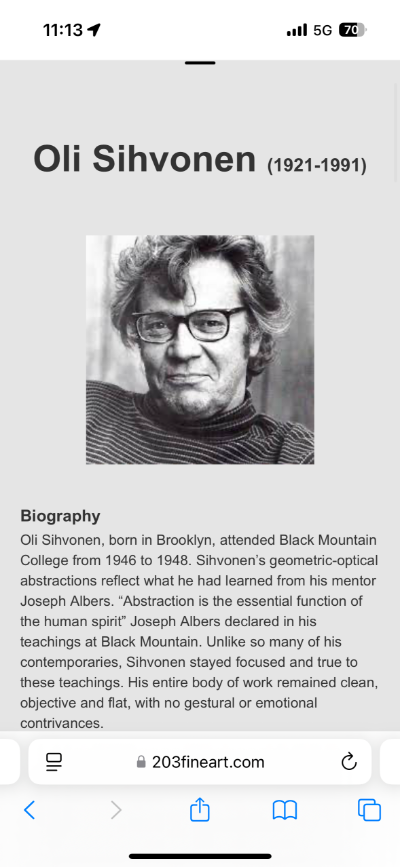
Oli Sivhonen
4521
Add photos & documents
Drop photos or documents here — images of the work, record cards, receipts, certificates, exhibition papers.
JPEG, PNG, WebP, or PDF, up to 25 MB each. You confirm what each file is before it joins the record.
Details
- Age
- 1957
- Style
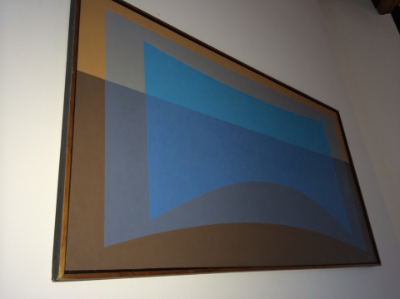
- Abstract, geometric, primary colors
- Artist
- Oli Sivhonen
- Origin
- Taos New Mexico
- Material
- Oil on canvas
- Condition
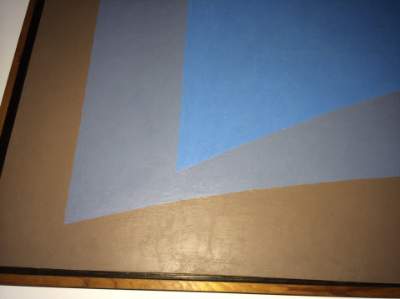
- Excellent
- Dimensions
- 30'' H x 55'' W
- Estimated Value
- $25,000.00 - $40,000.00
Conflicts
No open conflicts between this record’s accounts.
Description
Imported
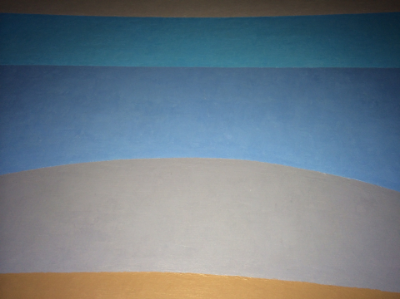
Postwar, 1957, geometric, brown, and blue, shaded large painting on canvas. Purchase from Aaron Payne fine arts in Santa Fe New Mexico circa 2010
Artist Bio
No entries yet.
Conversation
No entries yet.
Research
Type
This object is an abstract geometric American painting.
Description
Sihvonen typically signed works lower left or lower right as 'Sihvonen'; Taos-period works are often inscribed verso with title, date, and 'Box 563 Taos, N.M.'
Context
Sihvonen served in the U.S. Army during WWII in the 603rd Engineer Camouflage Battalion, known as the 'Ghost Army,' with which he served in Europe.
Context
Betty Parsons gave Sihvonen a solo exhibition at her New York gallery in 1962.
Context
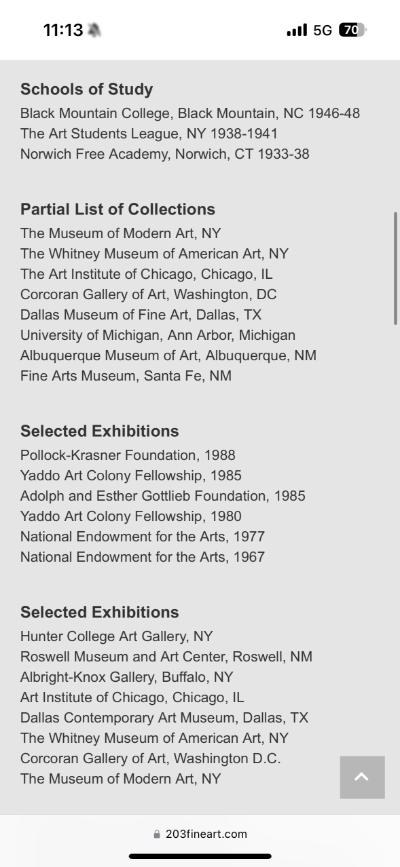
Works by Sihvonen are held in the collections of the Museum of Modern Art (NY), Whitney Museum of American Art (NY), Art Institute of Chicago, Corcoran Gallery of Art (Washington DC), Dallas Museum of Fine Art, University of Michigan (Ann Arbor), Albuquerque Museum of Art, and the Fine Arts Museum (Santa Fe).
Context
Sihvonen's work has been included in the Whitney Biennial and is held by the Carl and Marilynn Thoma collection.
Context
MoMA deaccessioned Sihvonen's Duplex (1963, oil on canvas, 56 × 52 in.) through Sotheby's in September 2025 to benefit its acquisitions program.
Context
The recorded auction market for Sihvonen is thin and illiquid, with roughly 20 recorded auction results concentrated at Wright, Rago, and Santa Fe Art Auction.
Context
Masonite-support works by Sihvonen appear to trade below canvas-support works at auction.
Owner Notes
Owner
Owner confirmed this attribution, per a research report: The painting was made by Oli Sihvonen (full name Oli T. Sihvonen).
Owner
Owner confirmed this attribution, per a research report: Oli Sihvonen was an American artist of Finnish descent, born January 31, 1921, in Brooklyn, New York, and died April 3, 1991, in New York, New York.
Owner
Owner confirmed this attribution, per a research report: Sihvonen worked in the movement of geometric abstraction and hard-edge painting.
Owner
Owner confirmed this attribution, per a research report: Sihvonen's style was shaped by Josef Albers, who taught him color theory and Bauhaus aesthetics at Black Mountain College in the 1940s.
Owner
Owner confirmed this attribution, per a research report: Sihvonen was influenced by Russian Constructivism and Piet Mondrian, and his work has been associated with Abstract Expressionism, Minimalism, Hard-Edge, and Op Art.
Owner
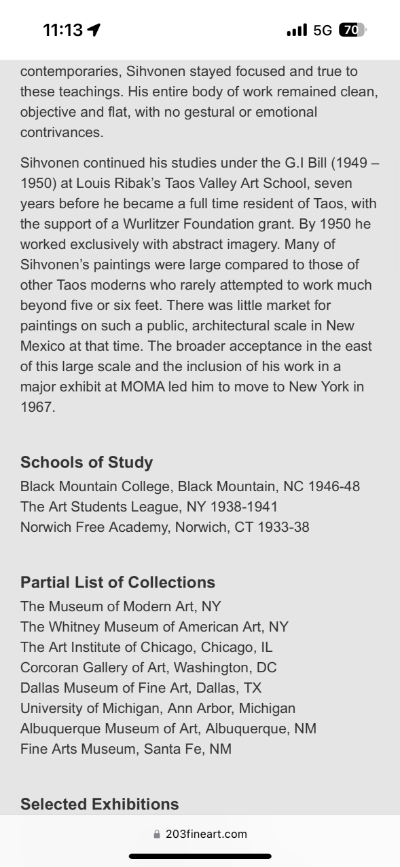
Owner confirmed this attribution, per a research report: Sihvonen attended the Norwich Art School in Connecticut from 1933 to 1938, then the Art Students League of New York from 1938 to 1941.
Owner
Owner confirmed this attribution, per a research report: Sihvonen continued his studies under the G.I. Bill (1949–1950) at Louis Ribak's Taos Valley Art School and became a full-time Taos resident with the support of a Wurlitzer Foundation grant.
Owner
Owner confirmed this attribution, per a research report: By 1950 Sihvonen worked exclusively in abstraction.
Owner
Owner confirmed this attribution, per a research report: Sihvonen's paintings were large relative to other Taos moderns; the limited New Mexico market for architectural-scale work, combined with a major MoMA exhibition, led him to move to New York in 1967.
Owner
Owner confirmed this attribution, per a research report: One dealer source dates Sihvonen's Taos residency as 1956–1967.
Owner
Owner confirmed this attribution, per a research report: Sihvonen held a teaching post at Hunter College in 1954 and at Cooper Union the following academic year.
Owner
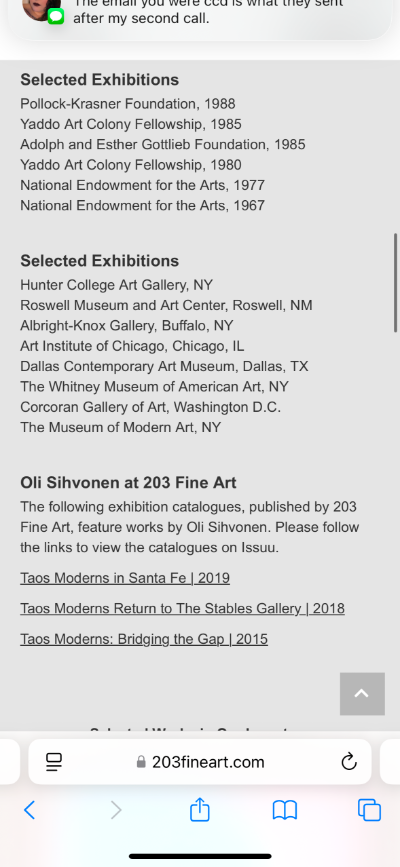
Owner confirmed this attribution, per a research report: Sihvonen received Yaddo fellowships and grants from the National Endowment for the Arts and the Wurlitzer, Pollock-Krasner, and Gottlieb foundations.
Owner
Owner confirmed this value estimate, per a research report: At Rago, Sihvonen's Dialogue Spring (1960, oil on canvas, 26⅛ × 20¼ in.) sold for $20,480 against a pre-sale estimate of $3,500–5,500.
Owner
Owner confirmed this value estimate, per a research report: Sihvonen's Green Leaf (c. 1965, oil on canvas, 24 × 30 in.) sold for $6,250 against a $3,000–5,000 estimate at Wright in 2018.
Owner
Owner confirmed this value estimate, per a research report: Sihvonen's Snowfall (1960, oil on masonite, 48 × 29½ in.) sold for $4,375 against a $5,000–7,000 estimate in 2020, below estimate.
Owner
Owner confirmed this value estimate, per a research report: A 1962 Sihvonen oil (25 × 34 in.) is listed at a retail asking price of $9,500 on 1stDibs.
Owner
Oli Sihvonen (Sivhonen), 1921–1991. Post-World War II American artist known for hard-edged abstract painting. Studied with Joseph Albers at Black Mountain College in the 1940s; also studied there with Buckminster Fuller, Bruce Cunningham, and John Cage. From Norwich, Connecticut. Art Students League 1938–1941. Moved to Taos, New Mexico in the 1950s.
Chat with this object
Ask about provenance, materials, or the artist's biography. Answers are grounded in this object's records; gaps are named, not invented.