Aluminum carved Vicuna
Jesus Valencia
4663
Add photos & documents
Drop photos or documents here — images of the work, record cards, receipts, certificates, exhibition papers.
JPEG, PNG, WebP, or PDF, up to 25 MB each. You confirm what each file is before it joins the record.
Details
- Age
- 2015
- Style
- South American carving
- Artist
- Jesus Valencia
- Material
- aluminum
- Dimensions
- 8'' H x 10'' W x 4'' D
- Estimated Value
- $2,000.00 - $3,000.00
Conflicts
No open conflicts between this record’s accounts.
Description
Imported
Purchased from the artist in Laguna, Chile on Bolivian border
Artist Bio
No entries yet.
Conversation
No entries yet.
Research
Object Type & Form
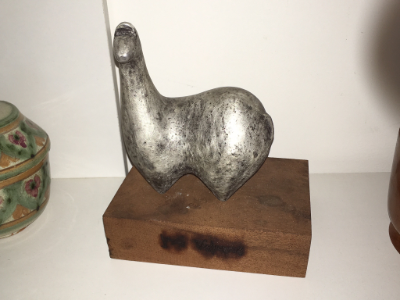
This is a freestanding figurative sculpture in the round depicting a vicuña — the smallest wild camelid of the South American Andes — rendered in a compact, highly simplified volumetric form and mounted on a wooden base. The sculpture belongs to the category of contemporary South American studio metalwork, produced as a unique object rather than an edition. It is catalogued under both Sculpture and Western Art collections, reflecting the owner's framing of it within a broader collecting context of objects acquired in the American West and hemisphere.
Subject & Iconography
The subject is a vicuña, a wild camelid native to the high Andean altiplano. Physically, the vicuña is the smallest and most slender of the South American camelids — distinct from the llama and alpaca — with a characteristically long neck, small erect head, and compact body. Valencia's rendering reduces this form to near-geometric volumes: the neck and head form a single arching curve, the haunches are rendered as a broad, rounded mass, and the limbs are suppressed or merely implied. The result is a sculptural language close to the cubist and minimalist aesthetic Valencia himself has described, defined by strong geometric figures, clean strokes, and a reduction to essential meaning. The vicuña holds deep cultural resonance in the Andean world. It has been regarded since pre-Inca times as a sacred animal — sometimes called the "herd of the gods" — and in Inca culture only the emperor and nobility were permitted to wear its fiber. Vicuñas appear in Andean rock art and continue to be honored in ritual contexts. Today the vicuña is Peru's national animal and a widely recognized symbol of the Andes. Valencia's sculptures are explicitly conceived as representations of Andean altiplanic cultures with a modern formal sensibility, making the vicuña a natural and symbolically loaded subject for his practice.
Historical & Cultural Context
San Pedro de Atacama, where Valencia maintains his studio, sits at roughly 2,400 meters elevation in the driest non-polar desert on earth. It is a historically significant crossroads of pre-Columbian Atacameño culture and sits near the Bolivian border — consistent with the record's note that the purchase was made in Laguna, Chile, on the Bolivian border. The Atacama region and the broader altiplano it borders were home to Andean cultures that produced rich traditions in metalwork, ceramics, and rock art; petroglyphs and geoglyphs of camelids are among the most common motifs in the region's ancient visual record. Valencia explicitly situates his practice within this inheritance, describing his work as bringing Andean heritage to contemporary form. The sculpture was made in 2015, six years after Valencia established his studio, placing it in a mature phase of his early output. The record notes that camelid figures — specifically llamas and figures drawn from petroglyphs — are among the most characteristic subjects of his workshop, a characterization confirmed by multiple independent visitor accounts and his online gallery listings.
Materials & Technique
The record identifies the material as aluminum. The catalogue photograph shows a silvery, matte-textured surface consistent with cast or carved aluminum. Valencia is documented as working in aluminum, bronze, and copper from his Atacama studio, and platform listings describe his use of aluminum as his primary sculptural medium, noting it as a highly malleable metal with a silvery appearance. The ArtMajeur listings for comparable Valencia works describe aluminum as cast in sand — a process in which a pattern is pressed into damp sand, removed to create a cavity, and then molten metal is poured in; the surface that results often retains a slightly granular, pitted texture. The photograph of this vicuña shows exactly such a surface character: an irregular, lightly pitted silver skin. The wooden base is a separate element, likely walnut or a similarly warm-toned hardwood; it serves as a display plinth and appears unremarkable. Dimensions are recorded as 8 inches high by 10 inches wide by 4 inches deep.
Record assessment
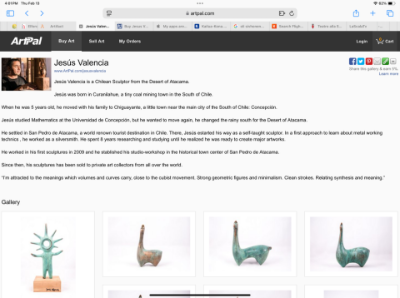
The record is well-grounded in its essentials: maker identity, material, subject, date, and acquisition story are all internally consistent and corroborated by multiple independent online sources documenting Valencia's practice in San Pedro de Atacama. The second photograph showing the ArtPal profile page is a useful provenance anchor. The surface texture and form visible in the catalogue photograph are consistent with Valencia's known aluminum work. What the record lacks is a purchase receipt or invoice, a gallery or seller name (the record notes only 'Laguna, Chile'), and any signed or stamped mark on the sculpture itself — none of the photographs show the underside or base where a signature or workshop stamp would typically appear. To materially strengthen this record, the owner should: (1) photograph the underside of the sculpture and the wood base for any signature, stamp, or inscribed date; (2) locate or reconstruct the purchase receipt, even a bank or credit card statement confirming a transaction in the Atacama region in 2015; (3) obtain a brief written statement from Valencia directly (he is reachable via jesusvalencia.cl and active on social media) confirming the work, which would serve as artist authentication; and (4) commission a formal written appraisal from a specialist in Latin American contemporary sculpture, since the current $2,000–$3,000 estimate rests only on the owner's assessment benchmarked against asking prices rather than realized sales.
From research, August 6, 2026
Owner Notes
Owner
Owner reviewed and accepted this attribution finding, as written, from a research report: The sculpture is attributed by the record to Jesús Valencia, a contemporary Chilean sculptor born in 1974. Valencia has lived in San Pedro de Atacama, in Chile's Atacama Desert, for more than twenty years and considers his works expressions of the ancestral cultures of the Andes. He apprenticed as a silversmith as a first step in learning metalworking, then spent eight years in study and research before producing major works. He established his studio-workshop in the historic town center of San Pedro de Atacama in 2009. The second catalogue photograph shows Valencia's ArtPal artist profile, confirming his identity, his Atacama base, his background as a self-taught sculptor who trained first as a silversmith, and the character of his practice. His works have been sold to private collectors from around the world who visit his Atacama workshop. The record states the piece was purchased directly from the artist in Laguna, Chile, near the Bolivian border — consistent with Valencia's documented practice of selling works from his studio to visiting collectors.
Owner
Owner reviewed and accepted this value estimate finding, as written, from a research report: The record carries an owner estimate of $2,000–$3,000. For context, a Valencia aluminum llama of comparable size (approximately 7–8 inches) is listed on ArtMajeur in the $2,000–$5,000 price band, and a smaller Valencia bronze face sculpture (approximately 7.8 × 5.5 inches) is listed on Saatchi Art at $1,850. These platform prices represent asking prices by the artist himself, not independently verified auction results; no secondary-market or auction comparables for Valencia's work were located in the searches. The owner's estimate of $2,000–$3,000 is broadly consistent with the artist's own retail pricing for aluminum works of this scale, though it sits at the lower end of the range suggested by the ArtMajeur listings. The vicuña is a somewhat less common subject in Valencia's documented output than the llama, which could affect relative desirability in either direction. No auction records, appraisal documents, or dealer invoices are present in the file to corroborate or refine the estimate independently.
Chat with this object
Ask about provenance, materials, or the artist's biography. Answers are grounded in this object's records; gaps are named, not invented.